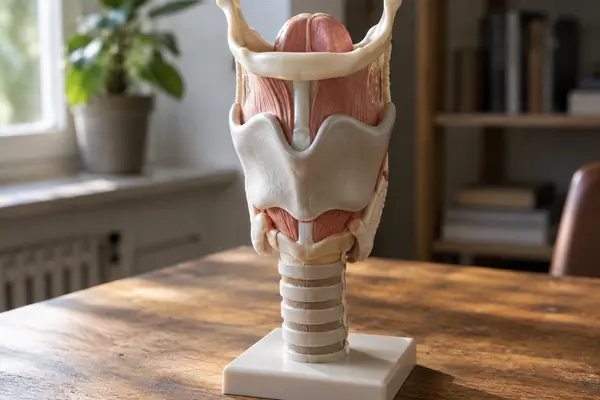
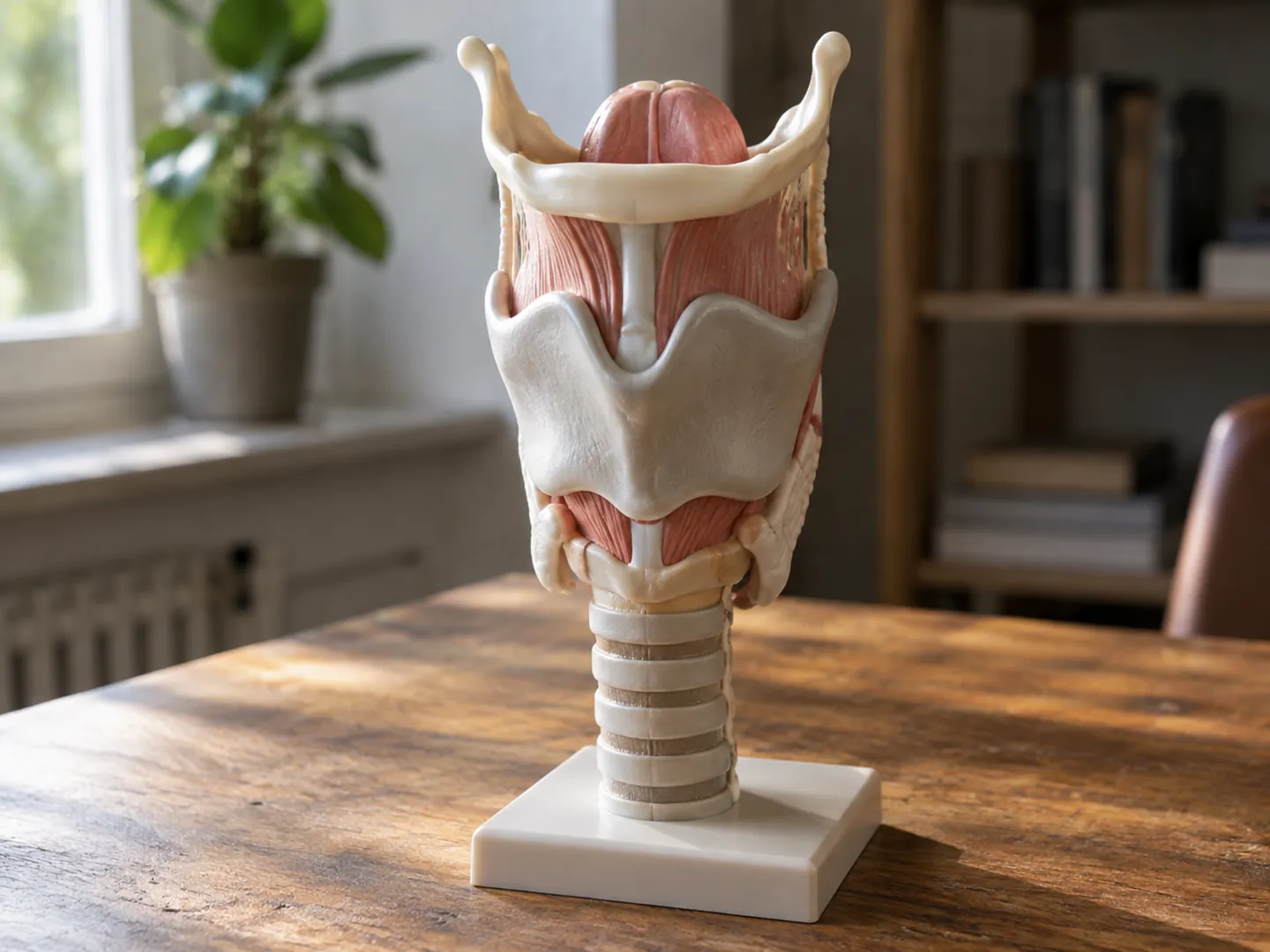
Air from the lungs sets two small bands of tissue in the voice box vibrating, and the throat, nose and mouth shape the result into speech or song. Voice clinics explain how it works, and why rest and water matter.
AI-generated image, not a photograph of a real person or place.
Lungs push the air
Folds make the buzz
Mouth shapes the sound
Three parts, one voice
THE SHORT ANSWER
Air, folds and a resonator.
The voice is a small machine in three parts. Change any one and the sound changes.
THE BUZZ
Two folds, closing fast
The vocal folds are two bands of smooth muscle tissue in the larynx. When you speak they close and air makes them vibrate more than 100 times a second.
Pick a voice to see roughly how many times a second the vocal folds open and close. One hertz is one vibration a second; the bar shows how high the pitch is.
Figures from the University of Minnesota Lions Voice Clinic. Each octave up doubles the frequency.
TWO NUMBERS WORTH KNOWING
Voice problems are common.
One figure on how many people are affected, one on when hoarseness deserves a check.
17.9 million
US adults reporting a voice problem
The US National Institute on Deafness and Other Communication Disorders estimates 17.9 million US adults report having a voice problem. Teachers, singers, sales people and public speakers are among those at greatest risk of voice injury.
PREVALENCE · NIDCD
> 3 weeks
Hoarseness that should be looked at
Newcastle Hospitals NHS Trust says a hoarse voice lasting more than three weeks should be checked by a GP. It notes most voice problems are not due to cancer, but this should be ruled out.
WHEN TO CHECK · NHS AND NIDCD
NIDCD also advises seeing a doctor promptly for coughing up blood, trouble swallowing or breathing, a lump in the neck, pain when speaking or swallowing, or complete loss of voice for more than a few days.
FOUR VOICE CARE HABITS
Look after the instrument.
These come from NIDCD's voice care advice. They are everyday habits, not treatments; anyone with a persistent voice problem should speak to a health professional.
Drink plenty of water
Especially when exercising, and balance any caffeine or alcohol with extra water.
Take vocal naps
Rest your voice through the day, and avoid speaking or singing when it is hoarse or tired.
Skip the shouting match
Avoid talking in noisy places, and use a microphone in classrooms, exhibit areas or exercise rooms.
Keep the air moist
Use a humidifier in winter or when indoor air is very dry; NIDCD suggests about 30% humidity.
AI-generated image, not a photograph of a real person or place.AI-generated image, not a photograph of a real person or place.
PITCH AND LOUDNESS
Tension for pitch, pressure for power.
Lengthening, thinning and tightening the vocal folds raises pitch; shortening, thickening and loosening them lowers it. Weill Cornell's voice institute explains that the outer covering, the mucosa, is the part that actually vibrates.
Loudness depends mainly on the air pressure from the lungs, with the folds tightening to stay nearly closed. Louder voicing makes each opening and closing more sudden, which sounds brighter but is harder on the folds.
Questions
Questions people ask
Where are the vocal folds?
In the larynx, or voice box, which sits between the base of the tongue and the top of the windpipe. The two folds stay open for breathing and close when you speak.
Why are men's voices usually lower?
Lower voices come from slower vibration. The University of Minnesota voice clinic gives an average of about 115 Hz for men in conversation and about 200 Hz for women.
Is whispering good for a sore voice?
NIDCD advises resting your voice when you are sick and avoiding both screaming and whispering.
How long is too long to be hoarse?
Both NIDCD and Newcastle Hospitals NHS Trust say hoarseness lasting more than three weeks should be checked by a doctor.
Who is most at risk of voice strain?
NIDCD names teachers, telemarketers, singers, lawyers, broadcast journalists, sales people and public speakers as at greatest risk of voice injury.